




What Un-inversion Means — A Fast Abstract
The US Treasury yield curve sometimes slopes upward, reflecting greater yields for longer maturities. It inverts when short-term yields (just like the 2-year) rise above long-term yields (just like the 10-year), often as a result of the Federal Reserve is aggressively tightening coverage.
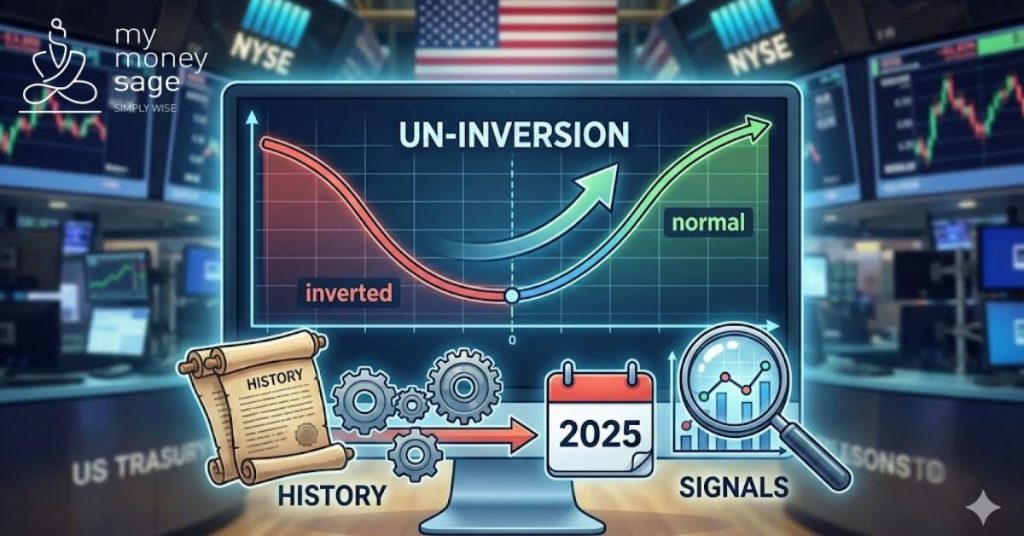
Un-inversion occurs when this inversion disappears and the curve returns to constructive territory. Whereas inversion will get the headlines, historical past reveals that un-inversion is the true recession sign. It marks the section when markets cease worrying about inflation and begin pricing in financial weak spot, Fed price cuts, and falling short-term yields.
As of December 2025, the US curve has been un-inverted for about 12 months, after decisively turning constructive in December 2024.
What Historical past Tells Us — The Recession Clock Begins at Un-inversion
Since 1970, each time the 10Y–2Y curve has been inverted for over 90 days, a recession has adopted 3 to 13 months after un-inversion. The inversion itself is the warning; the un-inversion begins the countdown.
Key historic episodes:
- 1989 cycle: Recession started 13 months after un-inversion. Markets rallied for nearly a 12 months earlier than the downturn.
- 2000 cycle: Recession adopted 3 months after un-inversion, coinciding with the Dot-Com bust.
- 2006–07 cycle: Recession started 6 months after un-inversion. Equities hit all-time highs simply 4 months earlier.
- 2022–24: The longest inversion ever (780 days). Un-inversion occurred in Dec 2024, making late mid-2026 the high-risk window.
Traditionally, buyers are likely to imagine within the “smooth touchdown” narrative instantly after un-inversion — and people phases have typically preceded main drawdowns.
The Present State of affairs — The “False Peace” of 2025
A File Inversion Adopted by a Flat Un-inversion
The curve normalized in December 2024, marking the official begin of the recession clock. Over the next 12 months of 2025, the curve has stayed barely constructive—hovering round +10 to +20 bps.
That is uncommon. Previous cycles noticed sharper steepening; this sluggish, virtually stagnant un-inversion has created a way of calm earlier than the storm.
A Shift from Bear Steepener to Bull Steepener
- 2023–24: Steepening occurred as a result of long-term yields rose quicker — signalling inflation persistence.
- Late 2025: The dynamic has shifted. Brief-term yields are falling because the Fed cuts charges, whereas long-term yields stay stickier.
This “bull steepener” is the traditional pre-recession setup often.
Weakening US Macro and Fee-cut Cycle
- Fed price cuts started in October 2024 and have continued into 2025.
- Cuts are not seen as pre-emptive assist — they more and more appear to be a response to softening macro indicators.
- Consumption, labour sentiment, and liquidity situations are displaying early indicators of pressure, even when headline GDP nonetheless seems agency.
AI Bubble Indicators — Echoes of 2000?
The present market construction attracts comparisons to the Dot-Com period:
- In 2000, the curve un-inverted in December; the bubble burst in March 2001.
- In 2025, AI shares stay up considerably year-to-date (+5% to +68% for Magnificent Seven), however November weak spot and stalled momentum regardless of sturdy earnings counsel that valuations have absolutely priced in AI advantages and markets at the moment are demanding proof of sustained returns. That is extra an earnings verification section than a liquidity disaster. The discount-rate sensitivity stays actual (as evidenced by sturdy late-November rally on price lower hopes), however the essential driver is now whether or not corporations can ship on the formidable progress assumptions embedded in present costs, not whether or not liquidity is offered at present costs.
The Three Preconditions Framework (Standing as of late 2025)
- Yield Curve Un-inversion: Partially glad; decisive steepening anticipated round late 2025–early 2026.
- Reverse Repo Balances: Declining however nonetheless elevated — signalling early-stage liquidity absorption.
- Fed Fee Cuts: Underway; affirmation of weakening momentum.
The alignment of all three has traditionally preceded recessions. At this time, two are partially met, one is ongoing — putting the financial system someplace across the center of the chance spectrum.
What the Current Alerts — Observations
Placing the historic knowledge and present context collectively, just a few inferences emerge:
- The US is in Month 12 of the everyday 3–13 month lag. This timeframe has traditionally been the “hazard zone,” particularly in cycles like 1989–1990.
- The curve’s sluggish and shallow un-inversion has inspired complacency, much like mid-2007.
- The Fed’s ongoing rate-cut cycle displays underlying financial stress, even when headline numbers nonetheless look secure.
- AI-heavy segments could possibly be the primary to react if liquidity tightens additional, much like 2000’s sample the place high-valuation sectors cracked earlier than the broader financial system.
- A ultimate melt-up in early 2026 can’t be dominated out. Traditionally, markets typically rally strongly between un-inversion and recession onset (e.g., 2007’s 48% Nifty rally within the analogous section).
None of those indicate certainty — solely that historic patterns and present macro situations are aligned in a method that often precedes an financial slowdown.
Last View
Taken collectively, the current atmosphere resembles earlier late-cycle phases the place the yield curve’s un-inversion marked a interval of “false peace” earlier than momentum cooled. Traditionally, episodes like 2000 and 2007 noticed comparable patterns — markets rallied, narratives of resilience grew louder, and solely later did stress floor after the un-inversion had quietly began the countdown. Whereas outcomes are by no means assured, the combination of weakening US macro indicators, ongoing price cuts, and rising nervousness round speculative pockets inside the AI theme has created a extra cautious undertone. These elements counsel the US financial system could also be transferring into the mature stage of the post-inversion lag that has, in earlier cycles, been related to rising recession threat.
Disclaimer:
This text shouldn’t be construed as funding recommendation, please seek the advice of your Funding Adviser earlier than making any sound funding resolution.
Should you shouldn’t have one go to mymoneysage.in

